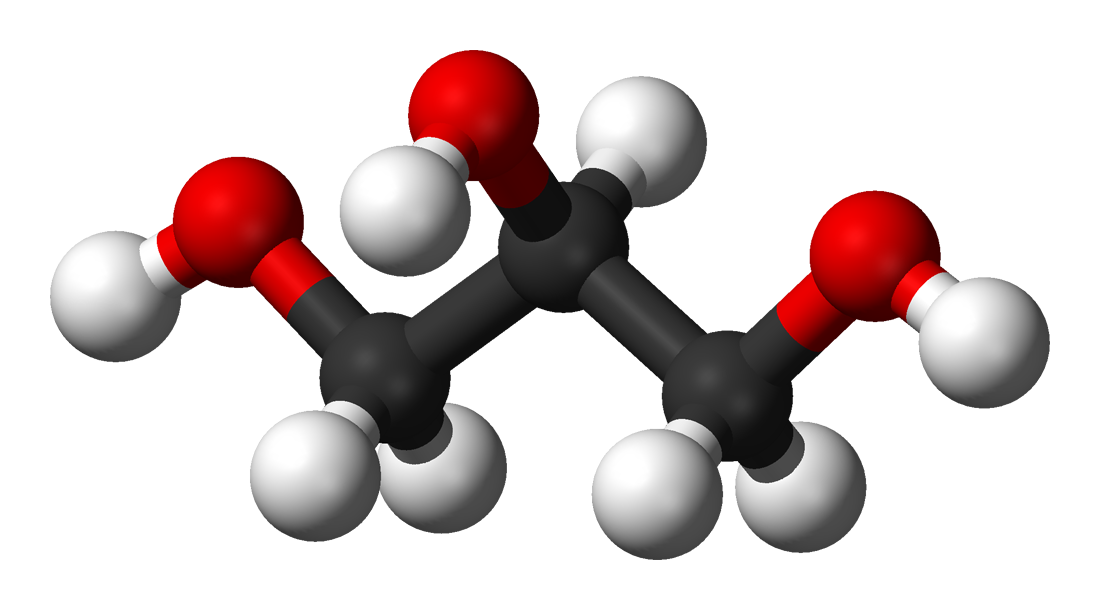

Glycerol (/ˈɡlɪsərɒl/) is a simple triol compound. It is a colorless, odorless, sweet-tasting, viscous liquid. The glycerol backbone is found in lipids known as glycerides. It is also widely used as a sweetener in the food industry and as a humectant in pharmaceutical formulations. Because of its three hydroxyl groups, glycerol is miscible with water and is hygroscopic in nature.
Modern use of the word glycerine (alternatively spelled glycerin) refers to commercial preparations of less than 100% purity, typically 95% glycerol.
Structure
Although achiral, glycerol is prochiral with respect to reactions of one of the two primary alcohols. Thus, in substituted derivatives, the stereospecific numbering labels the molecule with a sn- prefix before the stem name of the molecule.
Production
Natural sources
Glycerol is generally obtained from plant and animal sources where it occurs in triglycerides, esters of glycerol with long-chain carboxylic acids. The hydrolysis, saponification, or transesterification of these triglycerides produces glycerol as well as the fatty acid derivative:
![图片[1]-Glycerol-Hengya Group | Taya (Guangdong) Biotechnology Co., Ltd.](https://www.taiyabio.com/wp-content/uploads/2025/08/79693dfa1f20260723150035.png)
Triglycerides can be saponified with sodium hydroxide to give glycerol and fatty sodium salt or soap.
Typical plant sources include soybeans or palm. Animal-derived tallow is another source. From 2000 to 2004, approximately 950,000 tons per year were produced in the United States and Europe; 350,000 tons of glycerol were produced in the U.S. alone. Since around 2010, there is a large surplus of glycerol as a byproduct of biofuel, enforced for example by EU directive 2003/30/EC that required 5.75% of petroleum fuels to be replaced with biofuel sources across all member states. Crude glycerol produced from triglycerides is of variable quality, with a selling price as low as US$0.02–0.05 per kilogram in 2011. It can be purified in a rather expensive process by treatment with activated carbon to remove organic impurities, alkali to remove unreacted glycerol esters, and ion exchange to remove salts. High purity glycerol (greater than 99.5%) is obtained by multi-step distillation; a vacuum chamber is necessary due to its high boiling point (290 °C).
Consequently, glycerol recycling is more of a challenge than its production, for instance by conversion to glycerol carbonate or to synthetic precursors, such as acrolein and epichlorohydrin.
Synthetic glycerol
Although more expensive than production from plant or animal triglycerides, glycerol can be synthesized by various routes. During World War II, synthetic glycerol processes became a national defense priority because it is a precursor to nitroglycerine. Epichlorohydrin is the most important precursor. Chlorination of propylene gives allyl chloride, which is oxidized with hypochlorite to dichlorohydrin, which reacts with a strong base to give epichlorohydrin. Epichlorohydrin can be hydrolyzed to glycerol. Chlorine-free processes from propylene include the synthesis of glycerol from acrolein and propylene oxide.
![图片[2]-Glycerol-Hengya Group | Taya (Guangdong) Biotechnology Co., Ltd.](https://www.taiyabio.com/wp-content/uploads/2025/08/30b669acac20250923113248.svg)
The Role and Applications of Glycerol in Cosmetics
Glycerol (commonly known as glycerin) is a cornerstone ingredient in the cosmetics and personal care industry. Its popularity stems from a combination of key physical properties that make it exceptionally effective and versatile. Its primary role is that of a humectant, but it serves several other important functions.
Primary Role: Humectant
This is the most crucial function of glycerol in cosmetics.
- Mechanism: A humectant is a substance that attracts water from its surroundings. Glycerol’s three hydrophilic (-OH) groups form strong hydrogen bonds with water molecules.
- Action on Skin/Hair: When applied to the skin or hair, glycerol draws moisture from the deeper layers of the epidermis (the dermis) and, if the air is humid, from the atmosphere into the outer layer (the stratum corneum). This helps to:
- Hydrate and Plump: Increase the water content in the skin cells, making the skin appear smoother, softer, and more plump, which can temporarily reduce the appearance of fine lines.
- Improve Skin Barrier Function: Well-hydrated skin has a healthier barrier, which is better at protecting against environmental irritants and preventing transepidermal water loss (TEWL).
- Condition Hair: By attracting moisture to the hair shaft, it improves hair elasticity, reduces static, and adds shine.
Other Key Functions
- Moisturizer: While a humectant attracts water, a moisturizer helps to retain it. Glycerol is often combined with emollients (like oils and butters) and occlusives (like petrolatum or dimethicone) in formulations. The occlusive creates a barrier on top of the skin to prevent the moisture attracted by glycerol from evaporating, resulting in a powerful hydrating effect.
- Solvent: Glycerol is an excellent solvent for many water-soluble ingredients, helping to dissolve active compounds, botanical extracts, and fragrances uniformly throughout a product.
- Viscosity Modifier: Its thick, syrupy consistency helps to control the texture and thickness (viscosity) of cosmetic formulations. It can be used to create a richer, more luxurious feel in lotions and creams.
- Lubricant: It provides a smooth, slippery feel, which enhances the spreadability of products on the skin and improves the user experience.
- Protectant: It helps to protect the skin from irritation by creating a soothing, hydrating film.
- Preservative Booster: While not a preservative itself, glycerol’s ability to bind water (reducing “water activity”) can make it more difficult for microorganisms to grow, thereby supporting the efficacy of the product’s preservative system.
Common Applications in Cosmetic Products
Glycerol is a nearly ubiquitous ingredient found in a vast range of products:
- Moisturizers and Creams: Found in day creams, night creams, and body lotions for its hydrating and softening properties.
- Cleansers: Used in facial washes, shower gels, and soaps to prevent them from stripping the skin’s natural oils, thus countering dryness and tightness after washing.
- Serums: Often included in hydrating serums for its potent moisture-attracting abilities.
- Hair Care Products: A key ingredient in shampoos and conditioners to add moisture, manageability, and shine to hair.
- Oral Care: In toothpaste and mouthwash, it acts as a humectant to prevent the product from drying out in the tube and provides a smooth texture and sweet taste.
- Makeup: Found in foundations, lipsticks, and mascaras to improve consistency, provide a smooth application, and offer a moisturizing benefit.
- Sheet Masks and Toners: Used as a primary hydrating agent in these leave-on or wipe-on products.
- Soaps: Adds moisturizing properties and helps create a transparent appearance in transparent soaps.
- Deodorants: Helps to reduce irritation and provide a smooth application.
Why is it so Popular?
- Effectiveness: It is one of the most effective and well-researched humectants available.
- Safety: It is non-toxic, non-irritating, non-sensitizing, and well-tolerated by all skin types, including sensitive skin.
- Versatility: It performs multiple functions (humectant, solvent, viscosity controller) in a single ingredient.
- Biocompatibility: As a natural component of skin lipids, it is highly compatible with human biology.